



Leadership
- THE FUTURE CHURCH ADMINISTRATOR: 8 skills you will need by 2030

By Denise Craig, CAE, CCA The greatest challenge facing church executives might not be artificial intelligence. It might be whether enough leaders are prepared for what comes next. While much of the conversation focuses on technology, a quieter transformation is already underway. Church administration is expanding beyond managing operations into strategic leadership, risk oversight, talent development, and stewardship of the church’s future. By 2030, effective administrators will not simply keep the church running. They will help shape where it is going. The question is not whether the role will change. The question is whether today’s leaders are preparing for it. Here are eight skills you will need in this role by 2030. #1: Moving from manager to strategic leader Operational excellence will remain essential, but it will no longer be enough. Administrators will increasingly serve as strategic advisers who connect mission, people, finances, facilities, and execution. They will need foresight to anticipate consequences, recognize patterns, and help senior leaders translate vision into sustainable action. The strongest administrators will not wait to be handed a task. They will bring insight to the table before decisions are made. #2: Building technology fluency Future administrators do not need to become information technology experts, but they must understand enough to ask wise questions. Artificial intelligence, automation, data systems, cybersecurity, and digital communication platforms will shape everyday work. Technology can accelerate research, draft routine communications, organize information, and reduce repetitive tasks. #3: Strengthening human judgment As machines become more capable, discernment becomes more valuable. A tool can summarize a policy, but it cannot carry responsibility for a difficult decision. It can suggest language, but it cannot build trust after conflict. Church administration requires wisdom, spiritual maturity, context, and presence. By 2030, an administrator’s value might depend less on possessing information and more on knowing what to question, what to protect, and when a human conversation matters most. #4: Leading with data, not by data Churches have access to more information than ever, but information is not the same as insight. Administrators will need to recognize trends, interpret financial indicators, evaluate outcomes, and communicate what the numbers mean. Data-informed leaders use evidence to ask better questions while remembering that faithfulness, transformation, and relationships cannot always be captured on a dashboard. #5: Treating risk management as ministry stewardship Cybersecurity, privacy, employment practices, facility security, insurance, and compliance are not isolated technical concerns. Each can affect people, resources, reputation, and ministry continuity. Future administrators must help churches identify vulnerabilities before they become crises. Risk management is not fear-based leadership. It is responsible stewardship that protects the congregation’s ability to carry out its mission. #6: Developing people, not only processes Many churches are navigating staffing shortages, volunteer gaps, retirements, and leadership transitions. Administrators who can recruit, coach, mentor, and retain people will be indispensable. They must build healthy teams, clarify expectations, and create opportunities for emerging leaders to grow. Processes support ministry, but people carry it forward. By 2030, effective administrators will not simply keep the church running. They will help shape where it is going. #7: Making knowledge transferable Too many churches depend on information that exists only in one person’s memory. When that person retires, resigns, or becomes unavailable, essential work can stall. Future-ready churches will document recurring processes, cross-train staff, maintain accessible records, and create intentional handoffs. A job description explains responsibility. Transferable knowledge explains how the work actually gets done. #8: Investing in professional community As information becomes easier to obtain, trusted relationships will become more valuable. Policies, templates, and sample documents might be available instantly, but they cannot replace the wisdom of a peer who understands the weight of the role. Professional community provides perspective, accountability, encouragement, and shared learning. No administrator should have to navigate the future alone. The church administrator of 2030 will be a strategist, technology translator, risk leader, people developer, and guardian of organizational trust. The role will demand new competence, but its foundation will remain deeply human. The most effective administrators might not be those who know the most; they will be those who combine technological competence with wisdom, judgment, trust and connection, and then use all of it to strengthen the church for the future. Denise Craig, CAE CCA is a dynamic leader with more than 30 years of experience, currently serving as the CEO of The Church Network. She is passionate about helping others discover their God-given purpose and excels in strategic leadership. Denise is a member of the advisory panel for Church Executive Magazine, serves on the Board of Directors for the Tennessee Society of Association Executives, and is a frequent speaker at various events. She holds certifications as a Certified Association Executive, Certified Church Administrator, and Certified Financial Coach. Denise can be reached at denise@thechurchnetwork.com.
Risk Management
- THE RISKS YOU’RE NOT SHOWING: Why visibility shapes how your organization is understood

By Jon Barron When most organizations prepare for renewal, they gather the required information, complete the application, and trust the process. But what if the most important parts of your risk story never make it into that conversation? Applications, schedules, payroll, vehicles, losses, locations, and program descriptions all matter. But they mostly capture known, structured risks. They rarely describe operational reality: informal decisions, stretched teams, inconsistent follow-through, relational workarounds, or downstream exposure that does not fit neatly into a question on a form. What’s measured versus what actually matters That is where risk can be simplified too quickly. Insurance forms capture structured information, while real exposure often lives in complexity, exceptions and behavior. The result can be a picture that is technically accurate but practically incomplete. When visibility is limited When insurers lack visibility, they do not ignore the unknown. They account for it. Limited information can make an otherwise reasonable risk look more uncertain than it is. That does not mean the insurer is being unfair. It means the organization has not provided enough clarity to distinguish between a well-managed exposure and an unclear one. A trip described only as “100 youth traveling to Tijuana” might sound very different from a trip to a church-owned mountain camp an hour from the city, with known supervision, housing, transportation, and incident-response plans. Missing clarity can lead to higher pricing, added restrictions, more questions, or fewer insurance options. OUTREACH: Local & foreign missions Outreach risk often overlaps with people, health, and safety decisions. A local outreach event or foreign mission trip might involve transportation, volunteers, minors, medical needs, housing, security concerns, or informal partnerships. Before renewal, create a one-page outreach profile for any recurring or significant trip: where the team is staying, who owns or controls the site, who supervises, how transportation works, what medical or accident resources are available, and how incidents are reported. Depending on who is traveling, where they are going, the nature of the activity, and the terms of each policy, a health plan, accident policy, travel policy, liability policy, or other coverage might be involved. The goal is not to overwhelm the Insurer; it is to replace assumptions with useful facts before others fill in the blanks. Where ministries often under-represent risk Ministries often under-represent risk where the work is relational, decentralized or informal. A multi-site program might vary by location even when the description sounds the same. A trusted local partner might be mission-aligned and reliable, while still creating questions about contracts, responsibility, screening, supervision, or incident reporting. Workforce strain creates the same problem. When staff and volunteers are stretched, informal workarounds become normal. Processes might exist on paper, but real exposure is shaped by how often exceptions occur and whether or not anyone tracks them. The most consequential risks often sit in the gap between what the ministry says it does and how the work actually happens. Tell the full risk story Providing what is required is not the same as helping others understand how risk actually behaves. A stronger insurance presentation explains context, safeguards, governance and direction. It shows not only what the ministry owns or operates, but how people, programs, locations, partners and decisions interact in real life. Insurers rarely see the ministry directly. They see what is clearly explained by the ministry and its broker. Thin information forces assumptions. Clear information helps the ministry be understood accurately. CFOs and executive pastors should not wait until renewal week to see the organization from the outside. Build a simple risk inventory during the year. For each major program, identify who is served, where services happen, what transportation is involved, which volunteers or partners are engaged, and what incidents or near-misses would help explain the real exposure. Start with what would surprise an outsider One simple way to improve visibility is to ask before renewal: What would surprise an outsider reviewing us? The answer often points to the missing part of the risk story: a program that operates differently than described, a location with informal workarounds, a mission activity that depends heavily on volunteers, or near-misses that have not become claims. Once CFOs and executive pastors name those realities, they can decide what should be documented, explained, improved or elevated before insurers evaluate the ministry. What is unseen might still shape underwriting — often through assumptions made without your input. Jon Barron serves as a national director in Gallagher’s Religious Practice and National Director of Gallagher’s Citygate Insurance and Risk Management Program. He helps ministries understand risk, coverage, claims, and stewardship decisions in practical terms, connecting leaders with the right expertise so they can make informed choices with greater clarity, confidence, and alignment to their mission.
Pastor-Friendly A/V
- AI AND THE STEWARDSHIP OF YOUR CHURCH’S HISTORY

Years of ministry sit unused on drives across your campus. AI is how you find it again — and how you give your media team their week back. By Christina Kennedy Someone’s first introduction to your church happens on a Tuesday, on a lunch break, scrolling. They were not looking for a church. A 30-second clip of a message stops them, and something in it lands. By the time they walk through your doors, they feel like they know you. That clip did the work a lobby used to do. Your digital ministry is now one of the main ways people meet your church, stay connected between Sundays, and bring a friend. The problem is not a lack of footage Somewhere on your campus there is a drive with 2019 on it. Baptisms and testimonies, the mission trip that changed a family, three Christmas Eve services shot from four angles. Some of the most meaningful footage your church has recorded, and nobody can find it. The rest is scattered just as widely: drives on a shelf, an aging server sitting in a rack, a cloud account somebody set up years ago. Nearly every church has some version of this. That is where your team’s week goes Ask how your media director spent Thursday. Looking for a file, copying it between drives, waiting on a transfer, scrubbing hours of youth camp footage for a 90-second clip. They came to communicate the Gospel; they did not come to become IT specialists, sorting and moving video instead of telling the story. That is why the Tuesday clip does not get made. Not for lack of talent, and not for lack of footage. For lack of hours, spent looking. Finding what you already have AI earns its place in a church in a smaller way than the headlines suggest. It does the part no one has time for: knowing what is in all that footage. That is what we built creative.space Intelligence (CSI) to do. It looks across everything your church has recorded, wherever it sits, and makes it findable in plain English. Someone asks for sermon clips where the pastor references the book of Luke, and they come back in seconds. So does every shot of hands raised, because it reads pictures as well as words. The footage stops being lost, and the hours spent looking for it come back. Your team has the material and the time to use it, which is how a clip gets made on Tuesday and finds someone who was not looking for you. Giving your team their week back CSI also takes the first pass. Point it at Sunday’s service and it writes a transcript of everything said, identifies the key moments, and can assemble a rough cut. It can draft titles and descriptions, and translate and caption the whole thing in Spanish, so nobody waits on a volunteer to do it by hand. Your team starts from that instead of from scratch, and your editor still decides what goes out. No prompting skill to learn, nothing new for volunteers to figure out. creative.space gives your team an hour back a day. For a five-person team, that is 1,300 hours a year. At $20 an hour, well under what creatives cost, that is about $26,000 returned to ministry. Will it make our ministry feel manufactured? This is the worry we hear most from pastors, and it’s fair. Nobody wants a highlight reel that could belong to any church. But cookie-cutter is what you get when there is no time. A team that spends the week hunting files posts whatever was ready. A team with its week back can tell the story only your church can tell. Nothing here is invented. Every frame is still your people, your building, your Sunday, shot by someone on your team who was there. AI does not know your church better than you do. It has no sense of what your people need to hear, and it will never convey the Gospel the way someone who loves it can. That stays with your team. What AI gives back is their time. That is why churches like North Point Ministries, Saddleback Church, Church of the Resurrection, Lutheran Church of Hope, Rock City Church, and The Belonging Co., run their media on creative.space. Every message, every baptism, every story your church has already captured can keep serving your community. That is stewardship, and AI is what helps make that possible. Your message is competing with everything else on that phone. It can be paint-by-numbers. Or it can be yours. Give your team the hours back to tell your story. Christina Kennedy leads marketing at DigitalGlue and works with church media teams across the country. She cares deeply for the volunteers and staff who serve behind the scenes every Sunday, and for removing technology as a bottleneck so their churches can reach more people in their community and share the Gospel. Find her on LinkedIn. DigitalGlue has built and supported media infrastructure since 2001, including for Trinity Broadcasting Network and churches nationwide. creative.space is its creative operating system for modern ministry.
Mission & Travel
- Holy Land journeys: A disciple-making tool or Christian vacation?
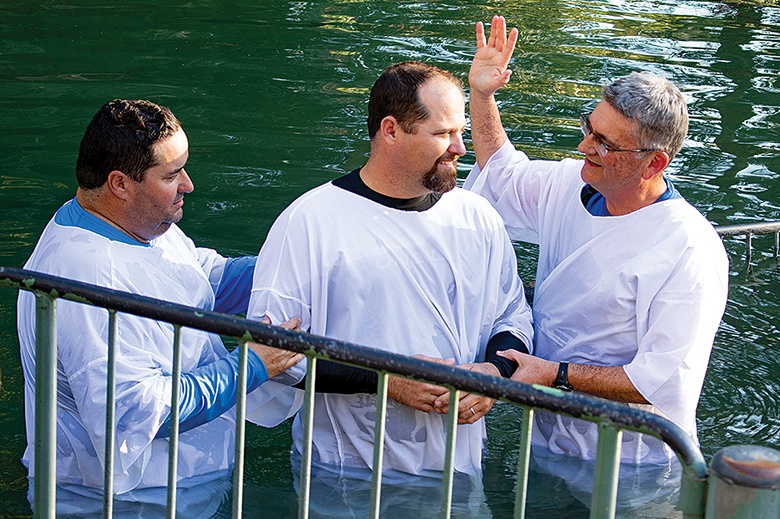
Walking in the footsteps of Jesus in the land of the Bible is the ultimate hands-on disciple-making experience for Christians — not just a vacation to a destination related to church. Educational Opportunities Tours (EO) President/CEO James Ridgway recently interviewed Rev. Tom Smith about how Holy Land journeys have changed lives and inspired the faith of people who traveled with him in the Holy Land. James Ridgway: How did your first Holy Land journey influence your life and ministry? Rev. Tom Smith: It’s safe to say that it began to affect me even before I returned home. But the immediately noticeable influence was the way that it affected my preaching and teaching. I found myself painting word pictures of a passage of Scripture as I would preach or teach. I would give little tidbits of what it means to go ‘up’ from Jericho or the winds affecting the Sea of Galilee as they funneled into that area. It was like I had an entirely new resource to add to my library as I prepared for a sermon or class. Ridgway: When did you decide to start taking groups to the Holy Land? How did the people respond? Smith: I went the first time without a group. But after returning, my excitement was obvious. I talked about it constantly. As soon as I was introduced to Educational Opportunities and learned of how I could ‘earn’ a trip, I decided to go back and take as many people as possible. As soon as I mentioned that I was putting a group together, people started signing up. A journey to the Holy Land is in the hearts of a lot of people — not as a vacation but as part of their faith development — so there was natural interest in participating. Folks were excited that they could travel with me because they trusted me as their pastor. Ridgway: Afterwards, what did you see in the lives of those who experienced the Holy Land? Smith: They were changed. They engaged with Scripture differently. They talked about the way they heard the sermons differently. They began to participate more readily in Sunday School, study groups or accountability groups. Many of them became more open and expressive of being leaders in the congregation. They have a renewed/revitalized faith, it seems. Ridgway: What other benefits come from the Holy Land journeys? Smith: One of the things was how close the group became. They bonded with each other as they shared the experience. They also bonded with me, as their pastor, differently. Instead of hearing me teach or preach a couple of hours per month, they spent 12 to 14 hours a day talking and experiencing this profoundly moving journey. We formed some truly lasting bonds. They also came back with a deeper understanding of the current issues facing people in the region. They experienced not just what the news media shared, but what they themselves saw. They could ‘put a face’ to it, and it opened doors/eyes in a way that nothing else could do. Ridgway: How does a pastor plan a journey to the Holy Land? Smith: There are two ways a pastor could begin this journey. First, they could participate in an EO Familiarization tour. After experiencing the Holy Land personally, they could start planning a group journey. Personal experience helps while recruiting a group. The second way is to jump right in and organize an EO Holy Land journey for their group by going to www.eo.travelwithus.com and reviewing the different itineraries offered and finding one that best suits what they and their folks would love to see. Then, they can reach out to the EO team to partner and build the journey that will help make disciples for Jesus Christ. The EO staff will provide all the tools necessary — including ongoing support — to build a life-changing tour for the congregation.